
 There’s an old joke about three generations of women in a family sharing a meal. It was the first dinner twenty-eight year-old Julia hosted for her mother and her mother’s mother.
She decided to make a set of favorite family recipes, an eye of round roast and vegetable casserole. She wanted everything to be perfect and followed the steps her mother followed.
While Julia prepared the roast for carving, her grandmother asked her why both ends of the roast had already been trimmed away. Julia explained that she just followed her mother’s steps. Her mother quickly added that she just followed her mother’s process. The family matriarch then tried to set the record straight.
“I just cut off the ends because the pan was too small.”
I thought of this story when I was on my recent trip to Albuquerque. Early in the day, before the mercury rose over one hundred degrees, my friend and host took me on a short drive to Petroglyph National Monument.
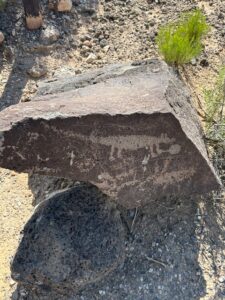
A petroglyph is an image created by removing part of a rock’s surface by scraping away the outer layer, engraving an image directly into the rock. The form of art is associated with prehistoric people and Native American tribes. I knew this was a key attraction in New Mexico so it was high on my list of things to check out.
My host was also a greeter and guide at a national park, so I got a little extra information. Petroglyphs are plentiful around Ricca Nada and Piedras Marcadas Canyons but there’s an easy trail around the Boca Negra Canyon, on the outskirts of Albuquerque.
The basalt, the outer layer of volcanic rock is black and soft, which probably lent to engraving. There are over a hundred such engravings and you don’t have to wander far off trails to find them.
I thought about this old story, about the three generations in a family doing something a certain way without knowing why. Their understanding was simply that the generation before did that thing that way.
Whether a family or regional custom is as basic as how to prepare dinner or what kind of family or tribe your son or daughter can respectably marry into, I’d guess there’s probably a pretty even ratio of traditions that preserve something that needs to be kept alive and some traditions that feed unnecessary comparisons and conflict.
So, after wandering around the rocks for a bit, I tried to categorize what I saw. There were engravings that seemed to capture the likeness of animals, like lizards, birds and fish, and other engravings that could be considered faces, and other designs that were less clearly representational.
I asked my hostess and guide a ton of “why” questions. I operated under the assumption that there had to be reasons for everything being a certain way.
Why did the petroglyphs of sea and amphibious creatures focus on lizards? Did the rivers around here dry up? Why were there designs that looked like stars within circles? Was this a tribute to clear desert night skies or to commemorate a rare event like a comet? Are scratching out these designs in rock part of a ritual? Why are they here?
After a short foray into trails at the mouth of the park, we got into my friend’s SUV (Everyone seems to drive white SUVs in New Mexico) and headed to a visitor’s center to watch a twenty minute video on petroglyphs.
It covered the formation of volcanic rock, the nearby Sandia and Manzano mountain ranges and tribes that were indigenous to the area, like Navajo and Zuni.
I was fascinated by interviews conducted. Several Native Americans, spoke of their mission; to preserve the artifacts carved in stone. They seemed less concerned with identifying an exact and singular explanation for different designs and methods for identifying the composition of the rock.
Some of these specifics might provide interesting factoids but didn’t alter the fact of these engravings being here and being worthy of appreciation.
I thought about the quip usually attributed to Sigmund Freud, who seemed to find sexual meanings in everything, referring to so many objects longer than wide as phallic symbols.
“Sometimes, a cigar is just a cigar.”
Living with an open-hearted acceptance of the knowable and unknowable is no small thing.



Leave a comment